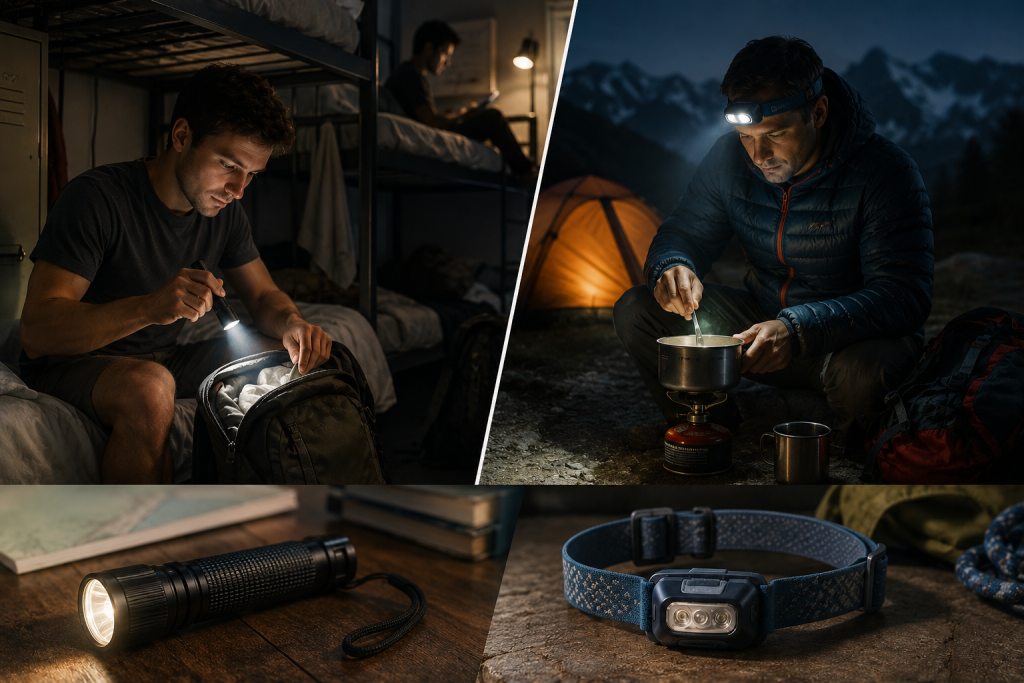
I wanted to take a closer look at travel headlamps, because they show up on a lot of packing lists. My recent post on travel flashlights sparked a bit of discussion, so it’s worth looking at why I tend to recommend a small handheld light instead of a headlamp. For most trips, I still lean toward a simple travel flashlight, which tends to be more versatile and easier to live with on the road. Why? On paper, headlamps seem like the perfect tool. Hands-free lighting, compact size, widely used by backpackers and outdoor enthusiasts. It’s easy to see why people default to throwing one into their pack. But like most travel gear, the real question isn’t whether something is useful. It’s whether it’s useful for the way you actually travel.
Headlamp vs Flashlight: What Actually Works While Traveling
This is where the decision becomes clear.
A small travel flashlight is simple, compact, and easy to use. You grab it, turn it on, solve the problem, and put it away. It works well in shared spaces and doesn’t draw attention. For most of the small, frequent tasks that come up while traveling, it’s the more practical option. A headlamp is more specialized. It’s designed for situations where you need both hands for an extended period of time. When you’re actually doing those tasks, it works extremely well. When you’re not, it tends to sit unused.
There’s also a practical consideration around power. Most headlamps use built-in rechargeable batteries rather than standard AA or AAA cells. That means you’ll need to carry a charging cable, which is one more thing to keep track of, one more thing to lose, and one more point of failure on the road.
If your trip is primarily urban, with hostels, hotels, and short-term stays, a headlamp quickly starts to feel unnecessary. Wearing one in a shared dorm is technically effective, but not especially subtle, and it tends to draw more attention than you want in a shared space. For basic tasks like finding something in your bag or moving around a room, it’s also more than you need.
If your trip involves camping, trekking, or extended time outdoors, the equation changes completely. Setting up camp, cooking, or moving around in the dark with both hands free is exactly what a headlamp is built for. In those situations, it earns its place quickly.
Most travelers don’t need both. If you’re choosing between a flashlight and a headlamp, the flashlight is usually the better default. It’s more versatile, easier to carry, and better suited to the kinds of small, frequent tasks that come up while traveling. If your trip includes real outdoor activity, then the headlamp becomes the better choice. In practical terms, a flashlight is a general travel tool. A headlamp is a task-specific tool. For most trips, general tools tend to win.
The 8KGap Filter
From an 8KGap perspective, the question is straightforward. Does this item earn its weight, its space, and its complexity? For most travel, a small flashlight does. It gets used regularly, solves common problems, and stays out of the way. A headlamp only earns its place if your trip actually requires hands-free lighting. Otherwise, it’s just extra gear.
A Simple Recommendation
If you do decide to bring a headlamp, keep it small, simple, and focused on utility. You don’t need high output or complex features. In fact, those tend to work against you in a travel context. A good example is something like the Petzl Bindi. It’s extremely lightweight, compact, and designed for exactly this kind of use. It has a low-profile design, simple controls, and enough light for practical tasks without being excessive. More importantly, it stays out of the way when you’re not using it, which is exactly what you want from travel gear.
The Bottom Line
Headlamps are excellent tools, but they are situational tools. For most travel, a small flashlight solves more problems more simply. A headlamp only makes sense when your trip actually demands hands-free lighting. Like most gear decisions, it comes down to being honest about how you travel, not how you imagine you’ll travel.